

At a small college in western Michigan, generations of students have spent weeks training for a tug-of-war that can last hours, involves hundreds of feet of rope and pushes its participants to their physical and emotional limits.
Unless you’ve attended Hope College in Holland, Michigan, there’s a pretty good chance you’ve never heard of The Pull.
And that's a shame, because The Pull has been around since 1898. Hope College describes it as one of the longest-running college traditions in the country, and it is generally recognized as the longest-running tug-of-war in America.
And calling it a tug-of-war doesn’t quite prepare you for what it looks like.
This isn’t two groups standing on opposite sides of a line at a company picnic.
It’s something else entirely.

Two Teams. One Rope.
The basic rivalry is simple: freshmen vs. sophomores.
But surrounding that simple premise is an elaborate system of teams, coaches, strategy, training and traditions that has evolved over more than a century.
Today, each side can have up to 18 Pullers on the rope and an equivalent number of Moralers, who act as the Pullers’ eyes, relay instructions and keep them focused. Freshmen are coached by juniors; sophomores by seniors. That creates another rivalry that extends across generations of Hope students: Odd Year versus Even Year.
The teams prepare for weeks.
Then comes The Pull.
The Pullers position themselves in shallow pits along the rope. Unable to see the opposition, they depend on their Moralers and coaches. On command, they heave together, then lock in and fight to prevent the other side from taking back what they’ve gained.
Then they do it again.
And again.
Potentially for three hours.
The modern rope itself is enormous. Hope's official history says the rope introduced in 2013 is 600 feet long.
It Started in 1898
The first known mention of The Pull appeared in the November 1898 edition of Hope’s student newspaper, The Anchor.
The notice was remarkably understated, essentially inviting students to come see a tug-of-war between the sophomores and freshmen, who were joined that year by students from Hope's then-existing high school.
Nobody involved could have known what they were starting.
Details from those earliest years are sketchy, and the event apparently went through periods when it wasn’t held. But by the early 20th century, The Pull was becoming recognizably the tradition that generations of Hope students would inherit.
And inherit it they did.
The Pull has survived two world wars, a flu epidemic, a pandemic and enormous changes in college life. Hope records only five years in which the event wasn't held: 1918, 1943, 1944, 1957 and 2020.
It continues today.

A Competition Capable of Going to Extremes
The Pull has produced some remarkable moments.
The shortest contest on record came in 1956.
It lasted just two minutes and 40 seconds.
At the other end of the spectrum was 1977. Neither side could finish the job, and the contest became an extraordinary test of endurance. Hope's current history records the 1977 Pull at three hours and 31 minutes, ending in a draw.
It led to an important change.
Beginning in 1978, The Pull was limited to three hours. If neither side claims the rope outright, judges can determine the winner by measuring the amount of rope gained.
And then there was the year they broke the rope.
When the Class of ’78 Broke the Rope — Twice

In 1974, the freshman Class of 1978 faced the sophomore Class of 1977.
The teams took the rope and threw their opening heaves.
The rope broke.
It was tied back together and the teams prepared to start again.
They threw another opening heave.
It broke again.
The Pull had to be rescheduled. But for the Class of '78, that was only the beginning.
They won that year as freshmen. A year later, they won again as sophomores.
Hope's records show that the Class of 1978 is one of only 22 classes since 1909 to win The Pull in both its freshman and sophomore years.
For those Pullers, the team had a name:
THE MACHINE
Nearly five decades later, the men who were part of those Class of '78 Pull teams don't need a history book to explain what The Pull was like.
They remember.
The practices. The pits. The rope. The coaches and Moralers. The exhaustion. The competition.
And the people beside them.
There are many videos showcasing The Pull: Through the Decades
and a short video remembering the '78 Pull Team — THE MACHINE', using photographs that bring some of that experience back to life.
WATCH: 78 PULL TEAM — THE MACHINE
What makes the old photographs interesting isn't simply the competition.
Look at the faces.
These were college students doing something together that was incredibly difficult—and creating memories that would follow them for the rest of their lives.
More Than a Tug-of-War
Perhaps that's the secret to The Pull's longevity.
If it were simply about determining whether freshmen or sophomores could pull harder, it's difficult to imagine the tradition surviving for more than 125 years.
Instead, former participants repeatedly describe it in terms of friendship, teamwork, endurance and discovering what they're capable of doing. Hope's own history of the tradition makes that point: winning matters, but participants often remember the relationships and the experience of pushing themselves beyond what they thought possible.
The competition has changed over the decades.
The way teams pull has evolved. Women became Pullers as well as Moralers, with Keri Law becoming the first woman selected as a Puller in 1995. The traditional Black River location eventually gave way to a campus site.
But the essential idea survived.
A rope.
Two classes.
Two sides that can't view when the other is about to heave.
And a group of people discovering what happens when everyone pulls together.
The Sporting Tradition You’ve Probably Never Heard Of
For something so intensely associated with one relatively small college, The Pull has occasionally escaped the boundaries of Holland, Michigan.
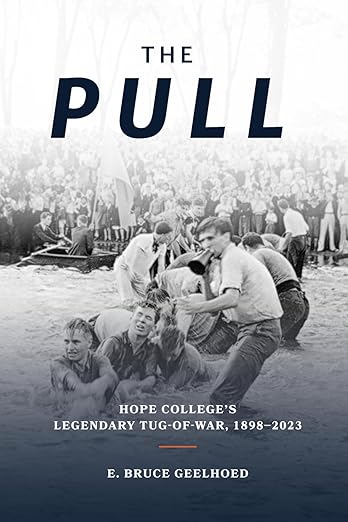
It has attracted attention from Sports Illustrated, Young Athlete Magazine, The Guinness Book of World Records, international media and television. Hope College even published an entire scholarly history in 2024: The Pull: Hope College's Legendary Tug-of-War, 1898–2023, by historian and former Pull participant E. Bruce Geelhoed.
And yet, outside Hope College and its alumni community, mention The Pull and you're still likely to get a puzzled look.
Maybe that's part of its appeal.
It remains a remarkably local tradition in an era when very little stays local.
Generations change.
The Pull continues.
If You Know, You Know
That connection to the past is also what inspired us to create a simple The Pull cap at YesterCool.
It was designed by a Pull alum for the people who understand what those two words mean.
No dates. No lengthy explanation.
Just: The PULL.

[SHOP THE PULL CAP AT YESTERCOOL.COM]
It's also a great gift for Pullers and former Pullers from spouses, family and friends—including those who've heard the stories enough times that they practically feel as though they were there.
Because more than 125 years after a brief notice appeared in a Hope College student newspaper, new generations are still taking hold of the rope.
The rope gets put away each year, but the memories don't.